Golyadkin’s failed reconciliation with his double
The DoubleGolyadkin’s failed reconciliation with his double is a coffee-house encounter in which a plea for an honest explanation briefly appears to open a way out of their conflict, only for Golyadkin junior to manipulate that hope into renewed mockery. Golyadkin’s attempt to make peace becomes a physical chase: after the double repeats a humiliating gesture, Golyadkin clings to his departing cab, is thrown into a courtyard, and flees through the snow. The scene makes reconciliation inseparable from exposure and pursuit, while ending with Golyadkin opening a letter whose contents promise a further turn in the story.
Causes and Background
Golyadkin pursues his double after the younger man has begun to retreat. The urgency of the chase does not bring confidence: Golyadkin feels immense energy and yet also a consuming weakness, as if an outside force were carrying him along and his legs no longer obeyed him. He thinks the game is lost and that he is done for, even as catching the other man’s overcoat gives him the sensation of having risen from the dead and won a victory. From the outset, his hope of recovering control is bound to a contradictory experience of helplessness.
The coffee-house proposal grows out of Golyadkin’s insistence that they settle matters openly. He tells his double that he has never been his enemy, attributes the hostility between them to spiteful people who have misrepresented him, and urges them to enter a coffee-house together so that the facts can be explained. The plea mixes an appeal to candour with a need to persuade his adversary to stay. Golyadkin junior accepts, but makes the meeting conditional on clearing things up, echoing Golyadkin’s own language while maintaining the air of a friendly companion.
The Coffee-House Meeting
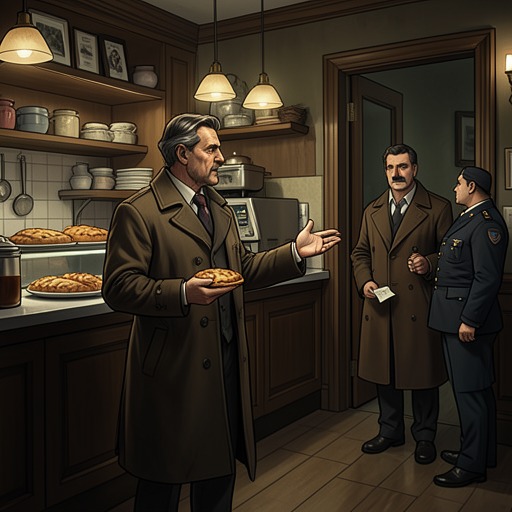
The establishment lies some distance from the main street and is empty when the two men arrive. A stout German woman stands behind the counter; in a second room, a boy tends a smouldering fire. Golyadkin junior orders chocolate and adds a tart, treating the encounter less like a grave reconciliation than an occasion for casual consumption and sly performance. The ordinary refreshments and nearly vacant rooms provide no shelter from the contest between the two men: even here, the double controls the tone.
Golyadkin tries to restore their former intimacy by recalling the happy moments they spent together under his own hospitable roof. His double counters by reminding him that Golyadkin’s letter said something quite different. Golyadkin concedes that the letter was an error and asks for it back so he can tear it up; if that is impossible, he begs his double to read it with the opposite meaning, as though its words had been written in a friendly spirit. His willingness to reverse the letter’s meaning exposes how desperately he wants the relationship repaired, but the appeal receives only a casual question in response.
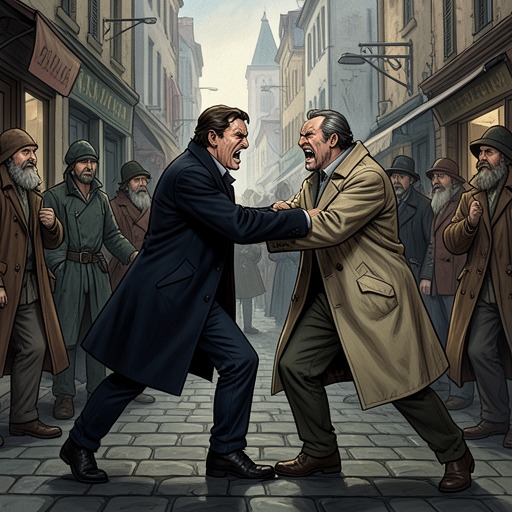
The double’s apparent warmth repeatedly turns into a means of insult. When he takes up his hat, Golyadkin senior rises too, still smiling simply and trying to encourage a new friendship. Golyadkin junior calls him “your Excellency,” and Golyadkin, seeking only to get rid of him, offers two fingers to the outstretched hand. The double seizes those fingers and repeats the morning’s shameful joke in front of him. What looked like a leave-taking becomes the decisive breach: Golyadkin’s patience gives way, and he follows his enemy into the next room.
Pursuit and Reversal
Golyadkin finds his double at the counter eating pies and making polite remarks to the German woman. He thinks he cannot confront him in front of a lady, but the double continues taunting him over the tart. The woman smiles without understanding Russian, leaving Golyadkin’s humiliation audible to his adversary but apparently unintelligible to the bystander. Golyadkin rushes at the younger man with the intention of destroying him; the double is already escaping toward the steps.
The pursuit is interrupted when the woman rings her bell and cries out as both customers leave without paying. Golyadkin turns back, throws down money for himself and for the man who has abandoned his share, and loses time in doing so. He nevertheless catches up with the cab. The double’s escape and Golyadkin’s decision to pay for both men sharpen the asymmetry of the encounter: even in flight, the younger man leaves his pursuer to manage the practical and social consequences.
Golyadkin clings to the side of the vehicle as the cabman urges on an exhausted horse with whip, reins, kicks, and shouts. He is jolted along the bad road while his double tries to shove him into the mud. Snow falls through the fog and creeps under Golyadkin’s unfastened overcoat; unable to make out the streets or direction of travel, he feels that the ordeal is somehow familiar and wonders whether he had sensed it in a dream. The pursuit stretches into a disorienting passage in which his bodily danger and uncertainty about what is happening reinforce one another.
At the height of his agony, Golyadkin begins to cry out, but the cries die on his lips. For a moment he decides that nothing can be done, that events are inexplicable and protest useless. A sudden jolt ends that suspension: he falls from the cab like a sack of flour and rolls on the ground. The fall changes the immediate course of the chase, but not the humiliation or confusion that have driven it.
Aftermath and Significance
The cab is standing in the courtyard of the house where Olsufy Ivanovitch’s flat is located. Golyadkin sees his double mounting the steps, apparently bound for Olsufy Ivanovitch, and considers following him; he prudently thinks better of it, pays the cabman, and runs off in another direction. The destination makes the double’s departure pointed: Golyadkin is brought to the very courtyard associated with Olsufy Ivanovitch, yet breaks away rather than pursue his enemy inside.
His flight carries him across Semyonovsky Bridge, where he trips over two peasant women and scatters their wares. He feels in his pocket for a rouble to compensate them, then discovers there the letter a clerk gave him that morning. Remembering a nearby tavern, he goes in, sits at a small table lit by a tallow candle, breaks the seal, and begins to read. The failed reconciliation thus gives way to a new documentary turn: after a scene dominated by the double’s words and gestures, Golyadkin’s attention shifts to a letter, and the narrative closes this episode at the instant before its contents can alter his understanding.